Tuesday, July 5, 2011

The Misery and Joys of Production

So we are in the 12th day of shooting.  I had about two hours of sleep last night before having to head into the day job today, so these thoughts are probably going to be a bit random. 

Production, as always, has been a test of patience, endurance, diplomacy, and leadership. I generally don't like production.  I always feel rushed, and bombarded with technical issues. I've always found production, due to having to cram so much into so little time, almost too high pressure to be truly relaxed and explorative creativity.  With a crew of three, executing a rather ambitious story in several spots all over Austin, we've all had to take on multiple tasks.  Thankfully, we've been shooting mostly at night, which is the most pleasant time to be outside in this grueling Austin summer.  (It's been consistently over 100 most days.) We did have a very difficult shoot during the day at the pool near my apartment complex.  The heat was so bad it shut the Canon 7D camera down three times.  We had to take it inside and place it near the air conditioner each time it stopped working then come out and shoot a bit longer until it shut down again. 

The worst night by far was the evening our Zoom H4n audio recorder pooped out.  We were so pumped for shooting that evening. The weather was in the 80s, slightly breezy.  We had found an incredible location near some train tracks where the city skyline was in view.  We had done two takes when suddenly the Zoom stopped working.  The cast waited around for about an hour while the crew and I called everyone in town we knew to see if another recorder was available.  Being after hours, none of the production gear rental houses were open.  To add to my frustration, as one of the producers was examining the Zoom, a fat ruddy-faced man out walking his numerous dogs aggressively questioned us.  He seemed very unhappy we were shooting a character sitting on a bench doing nothing.  I was not the one who spoke to him, but I really wanted to remind him that we were on a public sidewalk, in a public space, not defacing property, nor making noise.  There were only eight of us.  We were facing a public bench, not shooting his apartment or even pointing to the apartment complexes that were very far from us.  I just find it funny that if I had been drawing or playing music on that damn bench, he probably would have said nothing. What is so threatening about filmmaking in public spaces? Why is filmmaking considered more problematic of an art to create outside in the world?  As a tax payer, I have every right to film in the places I help pay for.  I know my limits when it comes to privacy, but let's face it, filming an actress sitting on a bench is not a threat to anyone, so fat man with your ugly dogs, let it be. Art is not a crime.

So, to continue on the Zoom audio recorder issue, we ended up having to move on without it, and pop off some shots where there was no dialogue.  I'll have to go back and get some ambient recordings of that area. Not a big deal.  But as I had scheduled some dialogue scenes that night, these scenes had to be moved to another day, which has put us about a day behind schedule.  I hope to be able to shoot some of those scenes tonight in addition to the scene already scheduled.

The best part of this process is being able to come home and watch the dailies and consume large amounts of red wine.  Even at 5 a.m., exhausted, there is nothing like looking at the rewards of the grueling process of being on "set."  Something I did not expect from this project is the tone it is starting to take.  Reviewing the footage of the day has brought a lot of unexpected laughter which has surprised me.  Before shooting, the film appeared to be a pretty twisted and rather dark. As this is an improv-based project, and I am not the writer but the director, I never know what the actors are going to bring and what the writer is helping them to understand about the scenes until we shoot.  So, I am getting many unexpected nuances in performances from the actors that I am really amazed by.  Actors have also brought in characteristics of their own lives and shaped characters in ways we never expected.  Because of this, it has made me rethink the purpose of scripted stories. This is a whole different topic, but basically it comes down to the saying that reality is stranger than fiction.  Scripts make my life easier as a director/producer, and I'll happily stick to this format in order to best plan my shots and schedules.  But rough outlines of scenes and unscripted dialogue brings out some very pleasant surprises. It's just hard to schedule around this sort of format, so perhaps for the future, schedule days a bit thinner to allow these improv scenes to really flesh themselves out.

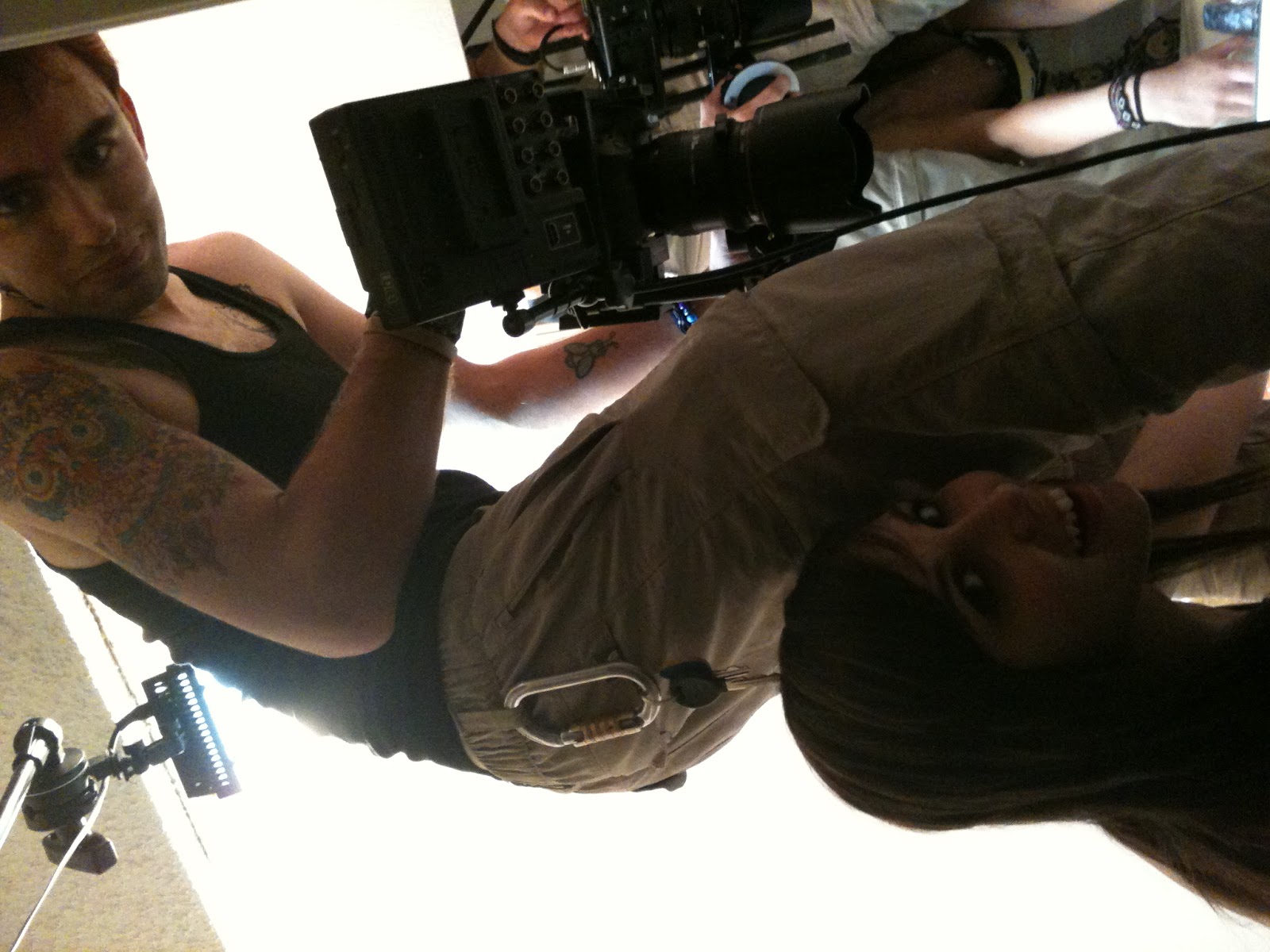
The imagery as well is quite stunning, and I can't believe we are pulling this off with the small crew we have, and with just two extra small battery-powered lights.  This is truly the most collaborative production I've worked on, and has taught me a lot about both the power and the difficulty of collaborative filmmaking at this level.  This is not "auteur-driven" filmmaking by any means as it is a combination of many voices and perspectives and everyone moving C-stands, holding batteries, etc. etc. at some point while shooting.

So, I trudge on through production, through the heat, the mostly curious passers-by and sometimes hostile dogwalkers, surviving off tea and potato chips on set, to amass the data on my harddrives at home, the beautiful puzzle pieces that continue to grow and delight. I cannot wait to cut them up and assemble them.

I'll post some stills here I've taken while on set.


More to come...

Friday, June 17, 2011

Day One Looms.

So, we are a week from shooting. It's been the usual non-stop pre-production hustle. I'm finishing the last of the props. Have just one VHS cover I need to design and print. I will be meeting some of the actors this weekend to hit up thrift stores and the like for their costumes.

Mike and I went around a few nights ago and ran some test footage on the Canon 7D. Here's a picture of the camera above. My landlord was none-too-happy about us shooting things around the apartment complex, so I had to reassure her we weren't spying into anyone's apartments, taking dirty pictures.  Frankly, most of the tenants at my apartment complex spend too much time on their couches eating frozen dinners and fried fast food, so honestly don't I think anyone would want to see them naked.

And as to be expected, we lost an actor playing one of our minor characters but we are on the hunt for the new one. I think we might have found him but will know this weekend.

We secured all of our locations as of yesterday. A car repair garage down in South Austin, with two horses on the lot, and lots and lots of cars.  Even an old vehicle from the 1930s with wood spokes on the wheels and an amazing interior in relatively in good shape. As I stared into the windows, I wondered who used to ride in this old car and what they wore, what was going on in their world when they were my age.

One of my actors, Joe Cheatham, had his hand molded by Meredith Johns and Jenny Lin, both very talented Makeup and Special Effects Artists here in Austin. Meredith has worked on a ton of big productions here in Austin.  Joe's picture is above.

With three producers on this project, one producing this film from out of town, it has been a true challenge to keep up communication.  Pre-production is never an easy time, and my least favorite part of filmmaking. Production is only slightly less stressful but more physically exhausting, but then follows the reward: editing. This is my favorite part of the whole process, where I and sometimes another Editor get to sit quietly in a slightly dark room playing with the images we have all worked so hard to capture, finding the nuances in performances, discovering connections, molding scenes and the pacing, and truly shaping the story into something we had never predicted while in development. 

Every time I am pre-producing a project and trying to get all the elements together in order to make the project happen, I always tell myself I want to make narratively simpler films, remove all the fluff and make things more sparse.  Partially to make this process less daunting, but also just to see what I have in a story when you get rid of the excess, cut the fat from the bone. 

One problem with this DIY/tiny crew approach is that I always spend about 90 percent of my film time towards producing, and about 10 percent of it actually thinking through the creative process as a director.  I've never really had the luxury of just being able to focus only on directing. It is just an amazing amount of work to be having to gather costumes, find props, create the props I can't find, make contracts, schedules, agreements, location hunting, testing equipment, that at the end of the day, my job as a director gets little love and affection.  I hope to shower it with kisses on set.

And being on set is where I really have to challenge the actors to push themselves, allow them to trust their instincts, give the DP some "dance" time as well, meaning let him follow his instincts too, becoming a "ghost dancer" around the actors.  The Canon 7D is small enough to allow him that mobility.  I don't think keeping the camera on sticks is going to work for the majority of this film, and we really have to do some bold things for coverage.  

The next six weeks will be interesting, shooting this film while working a full-time job in addition to my one-night a week part-time job (which will be B-Roll nights). Austin is blazing hot right now as well.  Windy.  They cancelled fireworks on the 4th and that was going to be a night where I got footage of the actors watching fireworks.  So...sigh...must think through this.  It's probably time for me to pull out Werner Herzog's journals about shooting Fitzcarraldo, his book Conquest of the Useless, to remind me this is not that difficult of a shoot at all. 

Wednesday, June 8, 2011

"What's the Use?" film update: Old Ladies, Fake Blood, and Near-Death Experiences

Last night, Mike, the DP of the film, wanted to show me two potential locations to shoot for the feature film project this summer: What's the Use?  We've been dealing with what to do about one character's house.  The "antagonist," Shy, a sorta sleezy car repair shop owner, lives with his suicidal mom.  The house we are probably going to use is probably not the best visual fit for him, as it looks like a bunch of 30 year-olds live there, but it's what we have.  Mike, the DP, thought he could show me another place. 


He called up a friend of his and off we went to check out the house.  Poor old lady was in the middle of watching her basketball game in a completely dark livingroom.  One wall was nothing but mirrors, which is interesting.  Had lots of ceramic statues, soft thick carpet. But the thought of having to put this poor woman out for five days while we had scenes involving the removal of a man's finger, a gun being fired, Shy looking up an Asian porn site, and a 14 year-old seducing a man just gave me the chills. Not to mention the fake blood we'll have to pour over the rug.  Even if we use a cheap craig's list rug, that crap will soak through.  No matter how hard one tries, fake blood will get everywhere.

So nix that.

The scariest part was yet to come.

Mike took me out to a narrow bridge over Mopac, one of the major north-south routes through Austin, to a set of train tracks.  We walked over the railroad ties, the fat rocks sliding under my thin shoes as we walked over the bridge.  This was not a pedestrian bridge, and was meant only for the trains that pass.  It was very dark but the way Highway 183 rose over the tracks and how Mopac traffic rushed below was really interesting as far as framing goes.  How we would light it was another issue.  We started to head back and are on the thin bridge over Mopac. It brought to mind the scene from Stand by Me where the kids are running over a bridge to get to the other side just in time before the train could have hit them.  Just as I am about to mention this scene, Mike calls:

"TRAIN!"

I turn to see a series of bright lights pummeling towards us. Where did this thing come from? We didn't hear it!  We quickly jump off the tracks to the side of the rails on this thin bridge while the horn blares at us angrily.  I grip the side of a waist-high bar and lean as far away from the train as I can, staring down at Mopac below me.  Mike, with the death wish he seems to have, enjoys the thrill of having a train pass four feet from his face at over 70 MPH while I just hope that there isn't some item projecting from the side of the train that is going to hit us or decapitate us.  My grandfather worked for the trains and an accident to his head from a train is what killed him.  The wind from this moving beast of iron and steel is pulsating around us and my heart is absolutely racing. It is probably no more than five feet from us and the only place to go involves walking beside it to get on one side of the bridge we are stuck on. I wait in true terror and as the cars' wheels click over the rails, and when I can get my breath back, I ask Mike to move so I can get past him and get away from this damn train.  I go hide in a bush.  Mike stays there watching this thing move like a snake.

Well, let's just say I felt sick.  Mike thought it was exhilarating. Yes it was.  But not in a cool way for me.  There are some risks I'll take in life, but I won't risk my life. 

Strange. Pre-production seems to be a period of danger for me I've noticed.  Last time, I was in my apartment going to get some coffee started before rehearsing with the actors.  As I was walking into the kitchen, I rammed my toe into a mirror and sliced off the toe nail.  That was a trip to the emergency room.  Funny thing is...we rehearsed the scenes in the emergency room.

Anyhow,  so I'm putting some photos up of some of the props I created for the film.  I think they are really funny.  The guide books I had particular fun with.  None of these books or cards are real!  So don't get any ideas...  


Wednesday, June 1, 2011

"Catma" project 2011: Finding the Gear for the New Feature Film

So, the story we are shooting is being called What's the Use for now. Jorge and I have bought some of the essentials we need for creating another film. This has been a challenge as neither of us make a lot of money, and by following the goals of "Catma," are trying to be resourceful with the small sum we have.

HARD DRIVE:  As this is a digital project, not to be shot on film (although I'd love to try this someday), we have to have a place to store the footage.  I refuse to skimp on the working drive because if this baby blows, there goes all the work. I've had great luck with CalDigit.  They were really supportive of us back in 2008 when we went to Puerto Rico to shoot In the Shadow, and arranged a very nice protracted payment plan for the drive. As our villas were without air conditioning, and the editing "suite" was a corner near the bathroom in one of the villas, the drive had to endure a lot.  The 8TB HDOne endured the heat, salty sea air, humidity, being on 24 hours a day for 6 weeks, plus traveling from the US, to a tiny Caribbean island, then back to the US. It's a tough hardworking drive.  I've also always found their support staff great to work with.  So, I went with CalDigit again and purchased a 6TB VR drive.

The space on this MIGHT be a bit of overkill after the DP and I did the math, but as this is largely an improv-based project, I know my shooting ratio is going to be higher than normal.  I usually average around 5:1 shooting ratio.

SOUND:  We had to get some good but essential sound recording equipment as we had none. This has been the hardest aspect of gear selection for Jorge and I.  After asking a lot of sound recordists out there, we chose to go with a Zoom H4n from Sweetwater Sound. Learning about lavalier microphones has been a bit of a mind boggler.  If we had all the money in the world, we'd obviously buy the absolute best.  But we don't.  So we purchased a Sennheiser ME4.  As we are trying to keep the crew small, Jorge and the writer, Jason Tremblay, will be taking a crash course in location sound recording from Martin Pedersen who did sound for my first feature, In the Shadow.  


Because it is cheaper than buying, we will be renting a boom pole (with Zeppelin/deadcat/etc) and a Rode NTG-3 shotgun mic instead of buying them.  Note that buying the Zoom was cheaper for us than renting.


CAMERA: Since one of the primary drawbacks for poor filmmakers out there is accessing equipment, we've structured "Catma" to encourage filmmakers to use whatever camera they have free access to. As I mentioned in a previous post, we were toying with the Canon Vixia which is just a consumer HD camera, or a Canon 7D, a far superior unit. These were the units we had access to. Of course, when one chooses a better camera, one has to think through other requirements needed. Better camera = larger file sizes for footage = larger hard drive = more back ups = more cash spent.  When it comes down to this, we had to just look at the far superior film we would have using the Canon 7D and accept the relatively small amount of extra cash we would have to fork out for this.

So, Michael Pugliese, the DP, will be using this Canon 7D, which he just purchased a "cage" for.  I have never used this camera and we'll be doing lots of tests at locations as I scout about Austin the next few weeks.  We also will be needing to acquire a shoulder mount for this.

Friday, May 27, 2011

Catma Project 2011: The feature now titled "What's the Use?"..for now

So, the first feature project we are attempting under the "Catma 2011" guidelines is now called "What's the Use?" At least, for now...

Without spoiling too much, it's about a young teen who goes out one summer night to seek revenge on a man who publicly humiliates and abuses her father at a barbecue party.  Along the way, she meets some interesting folks, has a brush with death, to learn that revenge is not always so sweet and the people we hate are more complicated than just your typical "bad guy."

Jason Tremblay is the writer.

We have no script...but, we have a set of scenes, seventy one of them to be exact, with the motivation of each character clearly defined.  It has begun as a series of color-coded sticky notes as in the picture above, and now it is in the process of being scheduled. I'm using EP Scheduling. This is the slow attentive part. Inputing each scene's costumes, characters, props, makeup, effects, vehicles, time of day, background characters, etc. It's a touch more complicated than a regular script as I'm working off a discussion with the writer and his sheet of scenes with descriptions like "J.C  wakes in Andrea's Arms."

After I have input each scene, I have to print "strip boards" for each scene which will allow me to move them around like bits of a puzzle around days in the calender for July and August of this year. This is the tricky part.  Working around people's schedules, trying to not move the locations much, blocking actors in chunks, etc...I actually really like this part.  I hate puzzles, which is odd, considering I actually like scheduling the shoot.
While I find this part of producing fun, it's also one of these processes that require a lot of focus, and an ability to be extremely thorough. If you forget to list a prop on one of these scenes or schedule an actor based on these breakdown sheets, your night of shooting might just be ruined. So I've just finished the first pass and will be coming through these sheets and least twice more.

Costuming is going to be tough as well as the presence of blood (there are a few gun wounds in this story) requires us to have at least 2 of each costume used in the scene where blood appears. For a tiny cast, my costume list has become quite long.  Sigh...

I'll also be scouting locations this weekend.  Most of the scenes occur at night, which helps with some noise issues and heat, but the lighting is going to be tricky. Can't have it all!

Tuesday, May 17, 2011

The new "Catma 2011" project continues...

So...it's been two weeks since I posted anything about the new "Catma 2011" project. Instead of floating around philosophies about it, we've decided to put our thoughts into action. We are shooting a feature length film in 2011 based on this DIY approach.  So, here's the update.  

We've chosen an idea for the film's story.  Since Catma is supposed to be about utilizing your resources, we've based the characters on actors/people we know, bringing in their own distinct personalities and traits to the characters they will become.

Because we want things to feel more "natural" and spontaneous, instead of writing a script where the dialogue is given to the actors, we are creating a road map of the story, scene by scene, with clear goals and directions for the actors to work with.  This will require the actors to be quite capable of collaboration, improvisation, or at least willing to take some risks with improvisation and exploration. 

So far, we will be a crew of three or four.  An editor to review to footage after shooting and begin an assembly cut.  A sound recordist. A director of photography. A director. 

Challenges abound however.

As Jorge and I have been bouncing around the approach, we've found ourselves having to be careful about "getting too big."  We've found ourselves talking about choosing equipment that goes beyond the budget, or equipment that would require having a larger crew than the current three or four people we have, and simply having to say outloud "STOP. We're going against our motto." We've had to also maintain this "keep it simple, keep it small" approach for the story and cast size.

Locations.  To keep things simple, all of the scenes should be able to happen just about anywhere. This has been tricky because naturally, as one tells stories, one sets the story in certain places or chooses specific actions.  Every scene must be able to be stripped of any expensive prop, costume, or be shot in a way that suggests it rather than show it.  All locations must be flexible.  

The camera: We'll be shooting without special lighting equipment, relying on whatever we light we have handy.  (It will be okay to utilize any light kits...but only if they are free and don't require a massive crew to move and set up.)   I'm currently testing footage on my Canon Vixia HF M31.  It's an HD camcorder but captures 24p recording at 60i. I've occasionally noticed some artifacts in the image that appear to be the effects of interlacing the image, especially when there is a great deal of movement.  Red Giant software makes a plug in that supposedly gets rid of that interlacing look, but as I ran some tests, it appears that six and a half minutes of footage would take about 22 hours of rendering time.  Crazy...so, that's a mark against using the Vixia. I'm going to continue to work with the footage and try some coloration using Magic Bullet.  

We might be using an Canon 7D, but more to come on that.


I'm both both nervous and excited to see what will come of this.  Movie making can be such a highly-controlled process, and I tend to gravitate towards controlling things because there is so much at stake, that this sort of come-what-may and let's-go-out-and-shoot something approach is definitely a challenge for me.  I'm seeing it akin to finding a box full of tubes of paint, grabbing a few colors, squeezing them in a cup, mixing them together to see what weird color results.  

Monday, May 2, 2011

The Creation of "Catma 2011"

So, Jorge and I decided to break away from our normal busy weekend film-oriented chores, and just head out in the heat for sushi at Sushi-a-Go-Go and a walk on South Congress.  Of course, we always talk film. We always talk about projects, creatively and pragmatically. Nothing we really mulled over was that much different than usual, other than we decided to put aside our high expectations of a nice camera (for now) and embrace a "fuck-all" approach.

Let me elaborate.

Jorge and I have always felt that most aspiring filmmakers in this country are hindered by two things: the belief their immediate lives are not interesting, and the mental "colonialism" by Hollywood's standards and aesthetics.  As media consumers, we are so inundated by Hollywood films, that if our own films don't match in some capacity, they simply aren't good.  Even "indie" films can be incredibly expensive projects that are out of reach for most creators.  Obviously there are exceptions, but as most filmmakers do have even cheap camcorders, making a film can be a much simpler process if we can just let go of these extremely high expectations we place on ourselves as artists. 

So, as Jorge and I dug into some delicious crepes from a street vendor on South Congress, we decided that it was time to revisit the "Dogme 95" rules of filmmaking that were established in 1995 by Danish filmmakers, the most notorious of the bunch being Lars von Trier. The rules were meant to make filmmaking a more accessible process without the incredibly huge budgets most films require. While little rules were broken all the time, the end result was still achieved: new films with different visions, focusing on story not technological pomp and circumstance, shot on cameras my mom could figure out. 

So, laughing, we decided to begin the creation of "Catma 2011," as a humorous spinoff on "Dogme 95."  It's not a reaction to Dogme, but more to the economic realities faced today by filmmakers. Most wait until they get "greenlit," constantly searching for the pot of gold, shopping around projects, searching for investors.  Years will go by and a film never gets made.

Our goal: to empower filmmakers at whatever technological level they are, to use the vast amount of accessible and affordable tools we have at our disposal, to create simple but effective and compelling stories.  We are not against technology, we are for ALL technology, as long as one jumps into using whatever tools they have. It's about making good stories, cheaply, and exploring the dynamic life that is just outside our windows.

We haven't solidified the list of "rules," as this is an exercise for us as well.  But as we plan the feature we wish to shoot , we will propose and post rules we wish to try out. For now:

1. use whatever image recording device you have free access to, wether it be an EPIC camera or your iPhone video recording device.
2. you may certainly use elaborate post effects, as long as they are free. 
3. never ever botch on sound, but find ways to make your onset recordings sound clean and pro, for cheap. If there is ever any element of production you should spend on, it should be assuring you get the best production recording you can. 

Strangely enough, we've been getting some strange "hints" of encouragement, little coincidental discoveries in alignment with our new goals.  This weekend we discovered a filmmaker by the name of Joe Swanberg who creates large amounts of material which he directs, shoots, and edits himself, with a micro-budget. He literally just jumps into his work and does it. I have yet to see any of his work, but plan to attend the Alamo Drafthouse showing of Uncle Kent in June. 

In addition, we attended a birthday celebration of a friend, and as we all sat down to catch up over our recent film forays, our friend expressed the truth that so many filmmakers spend so much time trying to launch one project, that they lose out on other opportunities to work on other ideas.  And the myth of the success story. For any successful project an artist creates, digging deeper will reveal numerous other not-so-successful projects he or she made. 

So, essentially, filmmakers must continually be creating work, with whatever tools they have access to.  Why should the big boys in L.A. have all the fun? 

So, I will continue to put updates here on Catma 2011 and the film we are looking to make.

For now, let's just say we are researching good but affordable sound recording devices and mics to use on a boom. We'll be using my mini Canon Vixia M31 HD camcorder. It's the size of a kitten.